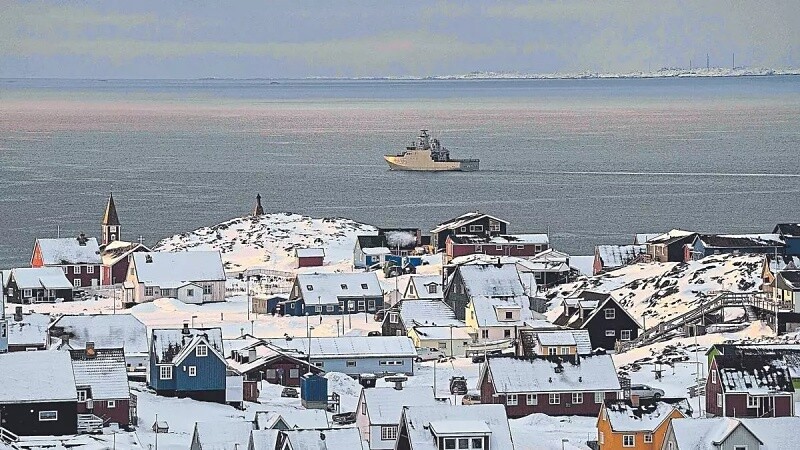
What was considered a peripheral and remote territory just a few decades ago is now consolidating as a key piece in the new international power map. Map of Greenland's strategic situation and natural resources, an island that the United States wants to control for 'national security'. Far from being a 'piece of ice', as Trump dismissed it in Davos, the island is consolidating as a strategic territory in the reconfiguration of global power. The dispute over Greenland exposes the wear and tear of the international order that emerged after the Cold War. Between militarization, extractivism, and the climate crisis, its people face the challenge of building sovereignty and autonomy in a world traversed by old and new forms of domination. By Nicolás Romano, for ANRed. What and where is Greenland? Greenland is the world's largest island (if we consider Australia a continental mass) and is located in the northeast of the American continent, between the Atlantic and Arctic Oceans. In this fragmented scenario, the island becomes a military, economic, and symbolic point of support for external actors. For Greenland, this centrality does not necessarily translate into greater sovereignty and faces a double challenge: to prevent autonomy from being subordinated to foreign interests and to build a horizon of self-determination that does not reproduce new forms of dependence. The future of Greenland is thus played out between powers disputing influence and a people seeking to decide its own destiny in a world in crisis. This reconfiguration anticipated many of the current debates around the Arctic, where military, economic, and environmental interests intersect, and where Greenland occupies an increasingly disputed place. Post-colonial stage: political autonomy in a context of dependence In 1953, Greenland ceased to be formally considered a colony and became part of the Kingdom of Denmark as a constituent part of its territory. Autonomy, in this framework, appears not as an endpoint, but as a field of open tensions between sovereignty, development, and sustainability. Greenland and the Arctic in dispute: geopolitics, climate change, and global power The accelerated melting of the Arctic has transformed the region into one of the most dynamic and disputed geopolitical spaces of the 21st century. What happens on the island dialogues with other scenarios where territories and populations are trapped between external geopolitical interests, regional power disputes, and projects imposed from the outside. In all these cases, the constant is similar: when decisions are made far from the affected peoples, sovereignty is emptied of content and self-determination becomes a rhetorical concept. Greenland shows that the challenge is not only to resist the pressure of the great powers, but to build real forms of political power from below, capable of disputing the meaning of development, territory, and the future, in an increasingly unequal and fragmented world. The island becomes an emblematic case of the tensions traversing the contemporary world: colonialism and autonomy, local sovereignty and global dispute, economic development and environmental justice. This militarization of the Arctic space developed without substantial participation from the local population, thus reproducing logics of subordination inherited from the colonial period. The growing U.S. presence structurally transformed Greenland's position on the international stage. In that context, Greenland acquired unprecedented strategic relevance, linked to its key location in the North Atlantic and access to the Arctic. Facing Denmark's inability to exercise effective control over the territory, the United States assumed a central role in its 'protection', with the approval of the Danish government in exile. From a colonial periphery to a strategic enclave of global power, Greenland today occupies a central place in 21st-century geopolitics. At this crossroads of forces, the Arctic ceases to be a distant space to consolidate as one of the central stages where the political, economic, and environmental dilemmas of the 21st century are played out. A future in dispute Between the aspiration for greater independence, the pressure of the great powers, and the climate urgency, Greenland faces decisions that will mark its course. The territory presents a landscape dominated by Arctic tundra and a polar and subarctic climate, strongly conditioned by the presence of sea and continental ice. Although its Arctic location and low population density gave it a particular dynamic, the logics of political domination, economic exploitation, and cultural control responded to classic colonial patterns, far from constituting a 'Nordic exception'. Greenland's colonial economy was organized around the exploitation of natural resources, mainly fishing and hunting marine mammals, whose products were destined for European markets. The island, due to its location and the wealth of its resources, thus becomes a coveted territory, traversed by logics defined far from Nuuk. However, this growing geopolitical centrality overlaps with a planetary-scale environmental crisis. Greenland is one of the territories most affected by climate change. In the name of development and economic autonomy, Greenland is pushed to integrate into an extractivist logic that deepens the climate crisis of which it is already a victim. In this sense, what happens in Greenland far exceeds its borders. The taking of key decisions continued to be concentrated in Copenhagen, while the local population remained on the margins of the major political and strategic debates. It was not until 1979 that Greenland obtained its first self-government statute, which allowed it to manage areas such as education, health, and social affairs. Far from being a closed episode, the colonial experience continues to influence current discussions on autonomy, sovereignty, and independence. Second World War, Cold War, and the emergence of the United States The Second World War marked a decisive turning point in Greenland's history. © Evgeniy Maloletka, AP However, towards the 15th century, European settlements were disappearing in a process that historiography calls the 'abandonment of Greenland'. The island was fully integrated into the defense system of the Western bloc and came to occupy a central place in the containment strategy against the Soviet Union in the Arctic region. For the United States, Greenland represents a central enclave in its northern hemisphere defense system; for China, an opportunity for access to critical resources and new trade routes; for the European Union, a space where economic, environmental, and security interests converge. This dependence curtails its margin of maneuver and conditions decisions on economic development, particularly in the face of extractive projects driven by foreign capital. The internal debate revolves around a central question: is it possible to advance towards greater sovereignty without reproducing an extractivist model that compromises the environment and local ways of life? Thus, the post-colonial stage of Greenland cannot be understood solely as a process of expansion of political rights, but as a scenario traversed by unequal power relations, persistent economic dependencies, and disputes over the control of territory and its resources. The population is concentrated mainly in small coastal cities, where climatic conditions and the natural environment directly influence daily life and economic activities. The capital and main urban center is Nuuk, which concentrates around 18,000 inhabitants and performs administrative, political, and economic functions, constituting the institutional heart of the island. Brief historical review: indigenous peoples, Vikings, and Danish colonialism Greenland has been inhabited since approximately 2000 BC, when the first Inuit peoples arrived from the Canadian Arctic. However, Denmark retains control of strategic functions such as defense, foreign policy, and security in the territory. This hybrid institutional scheme reflects a structural tension between political autonomy and real dependence. The relationship between colonizers and the indigenous population was marked by profound inequalities, with colonial authorities exercising direct control over daily life, education, and access to resources. During the 20th century, these policies adopted more subtle but equally profound forms. This model not only subordinated the local economy to the interests of the metropolis but also deeply transformed the traditional ways of life of Inuit communities, forcibly integrating them into colonial commercial circuits. On the social and cultural level, Danish colonization promoted assimilation policies aimed at reconfiguring the identity of the indigenous population. Under this argument, Washington established several military bases on the island during the war, destined for the control of air and sea routes between North America and Europe, as well as for the surveillance of the North Atlantic. Inequalities, economic dependence, and debates on identity and self-determination cannot be understood without this past. This process deepened in 2009 with the approval of the Autonomy Law, which expanded the competencies of the Greenlandic government and recognized the right of its population to decide on its political future, including the possibility of eventual independence. In the year 982 AD, Erik the Red was expelled from Iceland and undertook a journey to the west, where he explored the southwestern coast of Greenland. Upon his return, he organized an expedition with Icelandic settlers who established the first European settlements on the island, an episode recorded in the Icelandic sagas, such as the Saga of Erik the Red and the Saga of the Greenlanders. View of Nuuk, in Greenland, on January 14, 2026. Source: Descifrando la Guerra In this scenario, the United States, China, and the European Union seek to strengthen their presence in the region through investments, trade agreements, scientific cooperation, and strategic deployments. Despite institutional advances, the island continues to heavily depend on financial transfers from Denmark, which represent a substantial part of the public budget and operate both as a factor of stability and a concrete limit to effective autonomy. Among them, practices of reproductive control and forced relocation of populations stand out, facts that are today widely questioned and reviewed by the Danish state itself as part of a process of recognition of the abuses committed during the colonial period against indigenous communities. This colonial legacy left persistent marks on Greenland's social, economic, cultural, and political structure. The accelerated melting of its ice sheet not only contributes to the rise in sea level on a global scale but also profoundly alters local ecosystems and the ways of life of its population. These installations, including the Thule base, located in northwest Greenland, not only responded to the wartime needs of the conflict but also consolidated a U.S. military presence that continues to this day. Icebergs float off Nuuk, the capital of Greenland. Among the main hypotheses are the progressive disinterest of the Norwegian-Danish crown in the island, the overexploitation of the soil after centuries of productive activity, the impact of the so-called Little Ice Age, and conflicts with the Inuit peoples in contexts of resource scarcity. From the end of the 17th century, the renewed European interest in the resources of the North Atlantic, particularly fishing and whaling, led Denmark to reaffirm its sovereignty in the region. There he found fjords partially free of ice and lands suitable for livestock, covered with vegetation during the summer, which gave rise to the name Grønland/Greenland ('green land'). The same melting process that awakens the interest of the great powers and transnational capital is the one that threatens the environmental sustainability of the territory and the continuity of ancestral ways of life. Together with the Yupik, they form a set of peoples with a common origin, historically adapted to the harsh environmental conditions of the Arctic. Around the year 1000 AD, the Thule people, the direct ancestors of the current Inuit, arrived after migrating from Alaska, consolidating permanent human presence in the territory. A second chapter in the island's history is protagonized by the Vikings. The Inuit communities warn about the social, cultural, and environmental impacts of mining and extractive projects, which are often presented as the main, and sometimes only, possible path for economic development. The paradox is evident. Its territory was used for the deployment of radars, early warning systems, and air bases, becoming a key piece in the military fabric of the northern hemisphere. Under discourses of modernization and well-being, programs were implemented that intervened directly on the bodies of Inuit women and their communities. During the summer, coastal areas free of ice register temperatures ranging from 5°C to 10°C, which can reach higher values in the south, while in winter temperatures easily drop below -15°C and can be extreme in the interior and north of the island. Nuuk, capital of Greenland. Photo: Chris Christophersen/Shutterstock. It has an approximate population of 57,000 inhabitants, of which about 87% belongs to or descends from the Inuit people. The use of Danish as an administrative and educational language was promoted, the Lutheran religion was introduced, and the knowledge, practices, and forms of organization proper to the Inuit were delegitimized. Not as an exception, but as a synthesis of the central dilemmas of the 21st century. From a peripheral territory within the Danish colonial empire, it passed to become a strategic enclave of global reach. Photo: Odd Andersen/AFP. After the war, far from withdrawing, the United States reinforced its role within the framework of the Cold War. A military vessel in the waters near the capital of Greenland, Nuuk. The progressive opening of new maritime routes, access to strategic minerals such as rare earths, and the energy potential of the Arctic subsurface placed Greenland at the center of an increasing global competition. / AP The melting of the Arctic has once again made visible a dispute that comes from afar.